
I know you’re tired.
You’ve been scrolling through LinkedIn, watching other freelancers celebrate their wins while you’re still stuck applying to jobs that ghost you.
You’ve tried the “post your work daily” advice. You’ve joined every free webinar promising the secret to landing clients.
You’ve even paid for courses that left you more confused than when you started. And now you’re sitting there wondering if maybe, just maybe, you’re not cut out for this. Maybe freelancing isn’t for you. Maybe you should just go back to applying for full-time jobs and forget this whole thing.
But before you give up, let me tell you something: You are not the problem. The issue isn’t that you’re not talented or good enough. It’s that you’re not clear enough. Clients can’t hire what they don’t understand. When your message is vague, they scroll past you without a second thought.I know you’re tired.
You’ve been scrolling through LinkedIn, watching other freelancers celebrate their wins while you’re still stuck applying to jobs that ghost you. You’ve tried the “post your work daily” advice. You’ve joined every free webinar promising the secret to landing clients. You’ve even paid for courses that left you more confused than when you started. And now you’re sitting there wondering if maybe, just maybe, you’re not cut out for this.
Another problem? The advice you’ve been following. What worked in 2022 doesn’t work in 2025. Everyone’s using the same templates, chasing the same platforms, and saying the same things. So when you do exactly what everyone else does, you blend into the background.
You may also think your problem is your skill or your price. But here’s the reality: If you haven’t been clear about who you help and why they should hire you instead of every other person who does the same thing, your message becomes vague, and your effort becomes background noise.
Getting hired is simpler than you think. Be the clearest communicator, not the loudest. In this post, I’m going to show you exactly how to get your first freelance clients – not by following the same tired advice everyone else is giving, but by doing what actually works in 2025. No begging. No chasing. No waiting for luck.Let me tell you something: You are not the problem. The issue isn’t that you’re not talented or good enough. It’s that you’re not clear enough. Clients can’t hire what they don’t understand.
Another is the advice you’ve been following. What worked in 2022 doesn’t work in 2025. Everyone’s using the same templates, chasing the same platforms, and saying the same things.” You may also think that your problem is also your skill or your price. But if you haven’t been clear about who you help and why they should hire you and not every other person who does the same thing as you, your message becomes vague, and your effort becomes background noise.
Getting hired is simpler than you think. Be the clearest communicator, (and the loudest). In this post, I’m going to show you exactly how to get your first freelance clients not by following the same tired advice everyone else is giving, but by doing what actually works in 2025. No begging. No chasing. No waiting for luck.
Why Most Freelancers Struggle to Get Clients
Most freelancers approach getting clients like it’s random luck. Like if they just keep posting and hoping, eventually someone will notice them. But that’s not how it works.
When everyone is doing the same thing, nothing makes you stand out. A client scrolling through 50 nearly identical profiles won’t pause at yours unless you give them a reason.
After working with hundreds of freelancers, helping them get hired, I have realised that the reason is clarity. Who you help. What problem you solve. Why you’re different from the other 49 faces in the feed. Without it, you lose people before they even remember your name.
The freelancers who get hired don’t say “anyone who needs my services.” They say: “I help [this group] fix [this problem] so they can finally [get this result] without [this frustration]”
Once you’re clear, everything else becomes easy. You know exactly where to find them and how to star conversations. You stop talking like a desperate person and start sounding like someone who can really help them out.
Who says no to a helper?
Where to Find Freelance Clients (And What Actually Woks on Each Platform)
When freelancers ask me “Which app can I use to get a client?” I just shake my head because that’s the wrong question. It’s not about which app. It’s about matching the right offer to the right channel.
There is no platform that works. The platform that works is the platform where YOUR target audience are.
The mistake most freelancers make is using the same approach everywhere. They copy-paste the same pitch on LinkedIn, Upwork, Fiverr, and Reddit and then wonder why it feels like shouting into the void. Each platform rewards a different type of offer.
To effectively reach potential clients, freelancers need to recognize that their target audience is not uniformly distributed across platforms. For example, if you help fitness coaches, they’re probably not hanging out on LinkedIn. They’re on Instagram and TikTok. So if you’re spending all your time on LinkedIn trying to get fitness coaches as clients, you’re wasting your time. Not because LinkedIn is bad, but because you’re fishing in the wrong pond.
Your job is to figure out where the people you help actually spend their time. Then go there. Not everywhere. Just there.
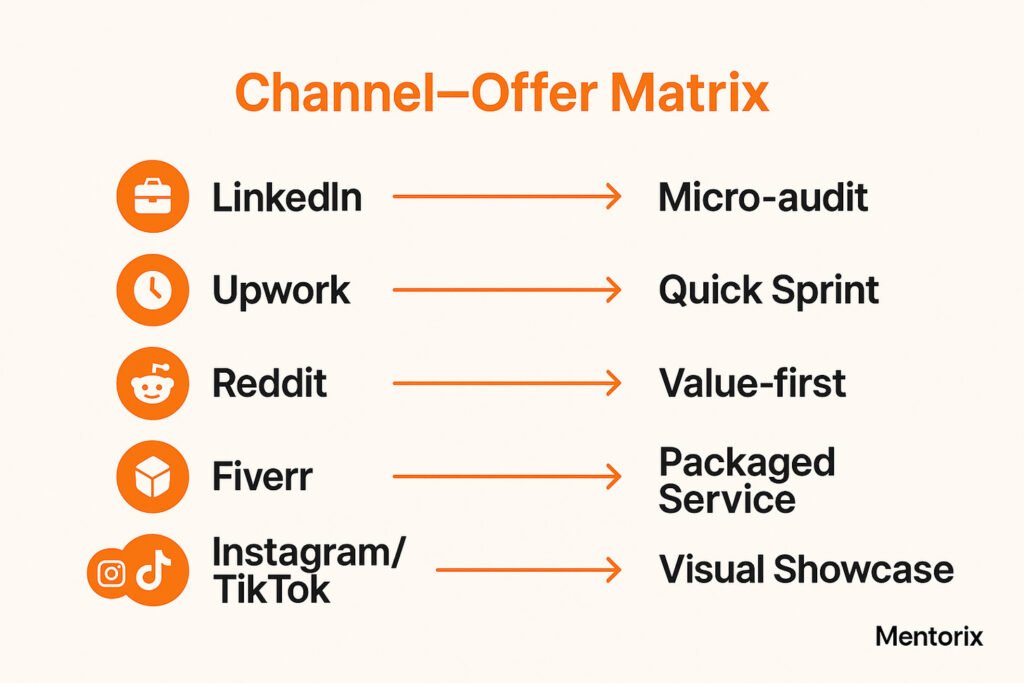
LinkedIn → micro-audit offers.
LinkedInworks if you’re targeting business owners, executives, coaches, or consultants. These people are on LinkedIn and are scrolling between meetings. They don’t want a long pitch, they want something sharp that makes them stop. That’s why a micro-audit works. Instead of saying “I’m a designer,” say: “I reviewed your landing page and noticed three quick fixes that could increase signups. Want me to walk you through them?”
That curiosity spark is what gets you a reply.
Upwork → quick sprints.
Reddit & communities → value first.
Reddit and online communities work if you give value first.In communities, trust comes before transactions. If you walk in selling, you’ll be ignored or banned. Instead, answer questions. Share a teardown. Help someone solve a tiny piece of their problem. Then when people ask how they can hire you, it’s a natural next step. Offer a low-barrier gig, like “I can write 3 LinkedIn posts for you for $100 if you want to make more sales.” You’ll be surprised how many DMs come from that.
Once you see it this way, you stop wasting time. Clients aren’t hiding. They’re on every platform. They’re just waiting for the right kind of offer, in the right place, at the right time.
So, go find where your damn people hang out. Then listen. The freelancers who win treat research like a habit, not a one-off task. They don’t wait for leads; they study the people who actually hire them.
The Key Principle to Getting Hired Is Clarity
Being the best technician won’t fix a weak pitch. Clients hire someone who understands their situation before the first call. Make them feel understood.
If you’re not sure who you should target, look at the clients who actually paid you and were happy. Who were they? What problem did they bring you? What result did you deliver?
Now write one line: “I help [who] fix [what] so they get [result] without [frustration].”
Example: “I help sustainability brands create content that converts eco-curious shoppers into loyal advocates.” Short. Specific. Hard to ignore.
![Notebook showing formula: “I help [who] solve [what] so they get [result] without [frustration],” a clarity method for freelancers to get clients.](https://mentorix.vip/wp-content/uploads/2025/10/Notebook-showing-formula-I-help-who-solve-what-so-they-get-result-without.jpeg)
Read your line aloud to one real person. If they ask questions with interest, it’s working. If they nod politely, it’s weak. Fix it.
Put that line everywhere: your website headline, email signature, and social bio. Make your personal brand tell the same story in every place people might find you.
State your process in one sentence. Clients trust a clear process more than vague promises. You’re not selling mystique you’re selling a predictable outcome.
And you don’t need better skills or lower prices. The real fix is a clear message that matches the people you want to work with.
How to Stop Clients from Ghosting You (And Get Replies Instead)
Questions I get a lot from my mentees, ‘How do I get more replies from people when I reach out to them in their DMs?’, ‘How to get freelance clients for free without spending money on Upwork connects or paying for pro on contra?’ or ‘How do I reach out to people in their DMs without sounding salesy?’
Whether you’re reaching out to them on social media, emails or sending proposals on upwork and contra, 2 factors influence their decision to say yes to you.
- Problem/Pain – They have a need or a problem that your skills solve.
- Relevancy & Confidence – They feel you’re relevant to them and they feel confident that you can help them achieve their goals.
But if you feel uncomfortable reaching out and afraid to sound salesy, it’s only because you’re approaching it wrong.
So, before you send that proposal, email or DM, ask yourself:
- Does this person have a problem I can solve? If yes, what is that problem?
Real world problem is not a problem. Conversion problems is not a problem, neither is business problem a problem.
A real problem is specific: “Their product page descriptions are confusing and people are leaving without buying.” “Their LinkedIn profile doesn’t clearly explain what they do.” “Their website takes 8 seconds to load on mobile.”
Most people get ghosted because their messages sound like everyone else’s. They lead with themselves instead of the person’s actual situation.
2. How do I show them I’m relevant and can actually help?
Relevancy: Reference something specific about their business or a recent post they made. This proves you’re not mass-messaging.
Confidence (theirs, not yours): This is about making the client feel safe choosing you. When someone doesn’t know you, they’re asking themselves: “Will this person actually deliver? Have they done this before? What if I waste my money?”
Your job is to answer those questions before they even ask. Show proof that you’ve solved this exact problem for someone like them. When they see you’ve done it before successfully, the risk feels smaller and they’re more likely to respond.
Do this and everyone you reach out to will respond.
How to Filter Out Bad CLients (So You Don't Waste Time)
Not every potential client is a good client.
When you’re starting out, you feel like you have to say yes to everyone. Like you can’t afford to be picky because you need the money and the experience. But working with the wrong client costs you more than saying no. A bad client drains your energy, wastes your time, and might not even pay you properly.
Remote work makes this even more important. You can’t walk into an office and get a feel for who they are. Everything happens through screens, so you need to spot warning signs early.
Red flags to watch for:
- They don’t treat you like a person. If someone is rude or dismissive from the first message, that’s who they are. It won’t get better, it will get worse.
- They won’t sign a contract. A contract protects both of you. Someone who refuses is either planning to take advantage or doesn’t take your work seriously. Always get it in writing.
- They don’t want to discuss what they actually need. If someone says “Just do it, you’re the expert” without giving context, they’re setting you up to fail. You’ll end up doing tons of revisions. Real clients collaborate. Bad clients want someone to blame.
- They want unreasonable access. I once had a client who wanted access to my entire laptop. No. Good clients only ask for what’s necessary like login credentials or access to the tool/file you’ll use, not your whole system.
- They refuse reasonable requests. If you ask for data you need to do the work and they won’t provide it, they’re making it impossible to help them. Some won’t show analytics dashboards or export insights, then expect you to fix problems you can’t see.
- They won’t agree to fair payment terms. Use part payment (half before you start and half after you’re done) or milestone payments: upfront, after first draft, after final delivery. This protects both sides. If someone refuses any structure that gives you security, walk away.
- Watch for remote scams: Requests to cash checks and send money back, overpayment with forwarding requests, jobs requiring upfront equipment purchases, or urgent pressure to start without vetting. I like to use 3rd parties to get these clients to hire me. Like contra.
- Trust your gut. If something feels off, if they’re evasive, keep changing scope, or make you uncomfortable, listen to that feeling.
You don’t have to work with everyone. The right clients exist. Ones who respect your time, communicate clearly, and pay fairly. Don’t settle just because you’re starting out.
How to Make $1,000/Month Freelancing
Let’s get practical. You want to know how to turn this advice into actual money.
Whether you’re wondering “Can I make $1000 a month?” or “How do I find clients consistently?”, the answer is the same: clarity first, then a simple system you follow every week.
So, before you do anything else: Get clear on who you help.
Write this down: “I help [specific type of person] solve [specific problem] so they can [specific result] without [frustration].”
If you can’t fill in those blanks clearly, you’re not ready to build a target list yet. Getting this clarity is the foundation. Without it, you’re messaging people who won’t care.
Do the math for your rates: At $500 per project, that’s 2 clients per month to hit $1,000. At $250, that’s 4 clients. The question isn’t whether you can hit $1,000, it’s whether you’re targeting clients who value your work and following a system to find them consistently.
Once you have clarity, build your credibility before you reach out. When people get your message, they’ll check your profile. If there’s nothing there showing you know what you’re talking about, they’ll ignore you.
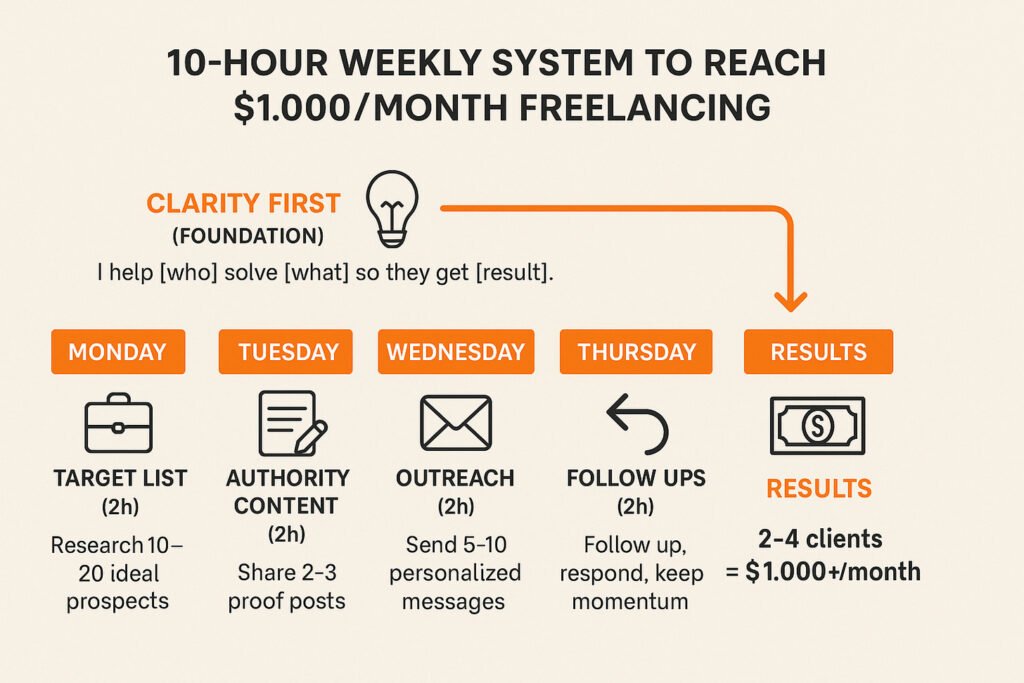
Spemd 10-hour weekly doing this:
Monday (2 hours): Build Your Target List
Now that you’re clear on who you help, research 10-20 people who fit that exact profile. Look at their websites, read their posts, understand their challenges.
Tuesday (2 hours): Create Authority Content
Before reaching out, post 2-3 pieces of content that demonstrate your expertise. This could be LinkedIn posts with insights, portfolio case studies, or quick tips. When people verify you’re legit, they need something to see.
Wednesday (2 hours): Send Personalized Outreach
Reach out to 5-10 people with real messages showing you understand their situation. They’ll check your profile. Make sure there’s proof you know your stuff.
Thursday (2 hours): Follow Up and Respond
Follow up with anyone who didn’t respond. Reply to ongoing conversations. Most people quit after one message. Send follow up messages!
Friday (2 hours): Review and Refine
What worked? What didn’t? What got responses? Improve for next week.
This system works because it’s sustainable. After a month, you’ve reached 40-80 potential clients. After three months, 120-240.
The math: If 5% become clients at $500 each, that’s $3,000 over three months. At 10% conversion or higher rates, you’re well past $1,000/month. The system isn’t sexy. It won’t make you rich overnight. But it will give you consistent income if you stick with it.
If you need help getting clear on what makes you different and how to package your offer so clients actually respond, our Client Acquisition Program walks you through that process.
How to Price Your Work Without Losing Your Mind (Or Your Client)
You freeze when it’s time to talk money. You’re terrified of charging too much and scaring the client away, or charging too little and looking desperate.
But pricing isn’t about finding one perfect number. It’s about knowing your range and being flexible within it.
Start with your value range
Before you talk to a client, figure out what the work is worth. Not what you think you’re worth as a beginner but what the actual problem you’re solving is worth to them.
If solving their problem saves them $5,000 or makes them $10,000, your work is worth more than $1000.
Write down two numbers:
- Top of range: The highest price that feels slightly outrageous but fair
- Bottom of range: The absolute lowest you can go without regretting it
How to have the pricing conversation
Start at the top of your range. Say the number unaplogetically.
If they say it’s too high, ask for their budget. If their number is within your range, you’re good. If it’s below your bottom line, ask questions that remind them of the value:
- “If I don’t solve this problem, what does that mean for your business?”
- “How much is it worth to you to have this fixed?”
- “What’s it costing you right now to not have this working?”
When you’re clear on the transformation you’re creating and confident you can deliver it, pricing becomes easy.
Structure your offers in tiers
Give clients options based on how much help they need.
Starter offer (low risk): The smallest thing that still provides value. For a content writer: “I’ll research your audience and give you 10 blog topic ideas with outlines.”
Main offer (full solution): The complete package. For a graphic designer: “I’ll create your complete brand identity – logo, colors, typography, guidelines.”
Premium offer (ongoing): The relationship-based option. For a web developer: “Full solution plus ongoing maintenance and monthly optimization.”
if you have zero testimonials?
Then your first project becomes about maximizing money. It’s about getting experience and testimonials. So, reduce their risk, not your price.
Walk them through your process. If you’re promising 10 sales per day, explain: “I’ll research your buyers, write copy that positions you as their best & only option, and optimize for SEO. With 500 daily visitors and a 2% conversion rate, that’s 10 sales – better than the zero you’re getting now.”
If they’re still hesitant, offer results-based payment: “Pay me a deposit to start. Once you see results after the first week, pay the rest.” Or be honest: “I’m building my portfolio. How about you pay me after I deliver the first result?”
People are human beings who understand hustle and honesty. Talk to them like real people, explain your situation, and most will work with you if they believe you can help them.
When you’re confident in your solution, pricing isn’t about convincing them you’re good enough. It’s about helping them see the value of fixing what’s broken.

What to Do Right Now
If you’ve made it this far, you might be feeling overwhelmed. You just absorbed a lot that contradicts what you’ve been told about freelancing.
Let me make this simple.
Get clear first. Write down: “I help [specific type of person] solve [specific problem] so they can [specific result].” If you can’t fill in those blanks, stop. You’re not ready for the other steps yet.
Pick ONE platform where those people actually hang out. Not five. One.
Build credibility before you reach out. Post 2-3 pieces of content showing you know what you’re talking about. When people check your profile after you message them, they need to see proof.
Create one portfolio piece. Show the problem, what you did, what changed. You don’t need past clients for this. Work on a realistic project that solves a real problem.
Talk like a human being. No templates. No AI scripts. Message people like you’d talk to your mom or your friend. Notice something specific about their work, tell them what you see, offer to help.
Watch for red flags. If someone’s rude from the first message, won’t sign a contract, or refuses to give you information you need to do the work, walk away. Your time is valuable.
Follow the weekly system. Monday research, Tuesday content, Wednesday outreach, Thursday follow-ups, Friday review. Ten hours a week, consistently.
Price based on value, not fear. Know your range. Start at the top. Be willing to negotiate within it. Structure your offers in tiers so clients can choose based on their readiness.
That’s it. Not 47 things. Eight things. Do these consistently for 30 days and something will shift.
If you want a complete step-by-step plan that shows you exactly what to do each week to get freelance job offers, download my free guide: How to Get a Freelance Job Offer in 2 Weeks.How to Get a Freelance Job Offer in 2 Weeks. It walks you through the exact actions to take so you’re not guessing.
You’ll start getting responses. You’ll start having real conversations. You’ll start seeing possibilities you couldn’t see before. And I know you’re scared. I know you’re tired of trying things that don’t work. I know you’re wondering if this time will be different.
It will be. But only if you take the first step. Your first client is out there. They’re waiting for someone who understands their problem and can articulate how to solve it. That someone can be you.
Conclusion
You’ve already got what it takes to land your first client. You don’t need more skills. You don’t need a bigger portfolio. You don’t need to be on every platform.
You need clarity about who you help and what problem you solve for them. You need to show up where those people actually are. You need to talk to them like human beings, not targets. The freelancers who succeed aren’t the most talented. They’re the ones who are clearest about their value and most consistent with their system.
Use the weekly routine I gave you. Build credibility before you reach out. Create portfolio pieces that show problem, process, and result. Price based on the value you create, not your fear. Watch for red flags and walk away from clients who don’t respect you.
And if you want a complete action plan showing you exactly what to do each week to get freelance job offers, download my free guide: How to Get a Freelance Job Offer in 2 WeeksHow to Get a Freelance Job Offer in 2 Weeks. It walks you through the specific steps so you’re not guessing.
Stop overthinking. Pick one person you want to work with. Research them for five minutes. Send one short, personalized message this week showing you understand their specific situation.
That single action matters more than another day of “getting ready.” Your first client is out there waiting for someone who understands their problem and knows how to solve it. That someone is you.
FAQ
How do I get my first client on freelancer?
Focus on clarity first, not platforms. Before you create an Upwork or Freelancer.com profile, get crystal clear on who you help and what specific problem you solve for them. Then create 1-2 work samples that demonstrate the outcomes you deliver, even if they’re not from paid clients. On these platforms, write proposals that show you understand the client’s specific situation, not generic copy-paste messages. Start with smaller projects to build reviews, then increase your rates as you gain credibility.
How to get freelance clients from home?
All freelance client acquisition happens from home in 2025. The key is knowing where your clients are online and showing up there consistently. Use LinkedIn for B2B clients, Instagram for creative work, Upwork for project-based opportunities, and Reddit for community building. Set up a simple weekly routine: research potential clients, send personalized outreach, create valuable content, follow up with people who engaged, and review what’s working. Remote client work is now the norm, so your location doesn’t matter. Your clarity and consistency do.
How to get freelance clients for free?
Every strategy in this post is free. It just requires your time and consistency. You don’t need paid ads or expensive tools. You need clarity about who you help, work samples that prove you can deliver, and a simple outreach system. Use free platforms like LinkedIn, Reddit, and email to reach potential clients. Create valuable content on social media to attract inbound interest. The weekly system I outlined costs nothing except 10 hours of focused effort per week. Most freelancers fail because they’re inconsistent, not because they don’t have a marketing budget.
How to get freelance clients in Dubai?
The same principles apply regardless of location. If you want clients specifically in Dubai, join Dubai-focused LinkedIn groups and online communities where business owners gather. Reference local business challenges and market conditions in your outreach to show you understand their context. If you’re in Dubai, use that as an advantage. Offer to meet in person, which builds trust faster. If you’re not in Dubai but want to work with Dubai-based clients, emphasize how remote work gives them access to specialized talent. Focus on outcomes that matter to Dubai businesses, not just your skills.
How to get freelance clients in India?
India has a massive freelance market, but it’s also highly competitive. Stand out by being specific about your niche and the problems you solve. Don’t compete on price alone. Compete on clarity and specialization. Use LinkedIn to target Indian startups and small businesses, join Indian freelancer communities on Reddit and Facebook, and leverage platforms popular with Indian businesses. Create content in Hindi or regional languages if that’s your strength. Focus on serving specific industries where you have unique insight or experience.
How do I get hired as a junior freelancer when everyone wants experienced people?
Stop competing on experience and start competing on clarity. Experienced freelancers often talk in jargon and assume potential clients understand what they do. You can win by being clearer, more specific, and more focused on outcomes that matter to your clients. When you can articulate exactly who you help, what problem you solve, and what result they’ll get, experience becomes less important. Clients hire people who understand their problems and can communicate solutions clearly. Your first few projects are about building testimonials and experience. Reduce client risk by offering milestone payments or results-based structures instead of dropping your price.